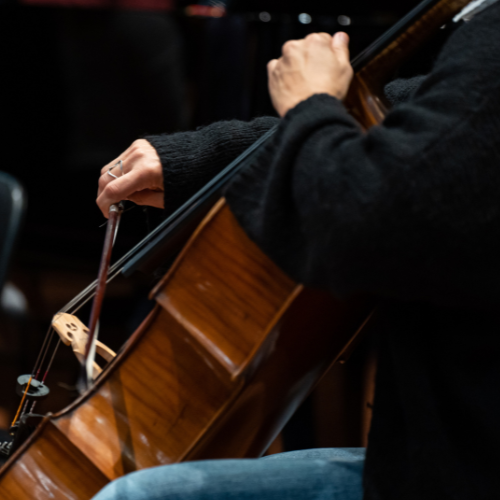
On Friday June 6 2025, the Music Performance Unit hosted musicians from the Australia Ensemble UNSW in an exciting workshop that focussed on the newly composed work by Natalie Nicolas, as part of her Layton Emerging Composer Fellowship.
The workshop ensemble comprised Daniel de Borah, guest piano; Julian Smiles, cello; David Griffiths, clarinet; and Airena Nakamura, guest violin.
Shortly after the workshop, we were lucky enough to sit down with David Griffiths, one of Australia’s leading clarinettists and core member of the Australia Ensemble UNSW. Here, he shared with us insights into his own professional practice when it comes to working with emerging composers and workshopping new chamber music works with the ensemble.
MPU: What excites you the most about being involved in a workshop for newly composed chamber music?
David Griffiths: I get incredibly excited about playing something completely new for the first time, not being influenced by how someone else may have previously played it, and being completely free to interpret the new work however I like. (Within reason of course!).
And then on the day, getting to work together with my wonderful colleagues and the composer, to bring it to life. It doesn’t always happen immediately, but it is really interesting to see how the new work can take shape over the course of a few days.
MPU: How does your practice change when you are workshopping a new piece, as opposed to an established piece of music?
David Griffiths: Often when you are preparing an established piece of music, you might have played it before, or at the very least there are several recordings that you can refer to in preparing for the rehearsals. In addition to this, there is often a particular style of music that you know it will be, so you already understand the type of music you are preparing, even if you haven’t played it before.
When it comes to a completely new work, and in this case, of a composer that I have not played before, it is a completely blank slate, so my practice just involves learning my part, along with studying the entire score to see how my part fits in, and then coming into the workshop with a completely open mind in terms of style and approach. Each musician brings their unique perspective and impressions of the new work which is a very interesting part of the process.
MPU: What are some of your rehearsal day non-negotiables?
David Griffiths: Well, I definitely need a coffee, and I need to make sure I have some time for a good warm up which includes some long tones, scales and articulation exercises. That way I feel ready to tackle anything!
MPU: Could you describe in a few words what Natalie Nicolas' new work evokes for you so far?
David Griffiths: I find it quite meditative.
We loved getting this behind the scenes look into what it is like to work on a newly composed chamber music work, and hope this interview encourages, as well as inspires emerging musicians to seek out and/or compose new work in the future!
The applications for the 2026 Layton Emerging Composer Fellowship are now open until August 22 2025. Visit https://www.music.unsw.edu.au/opportunities/layton-emerging-composer-fellowship for more information.