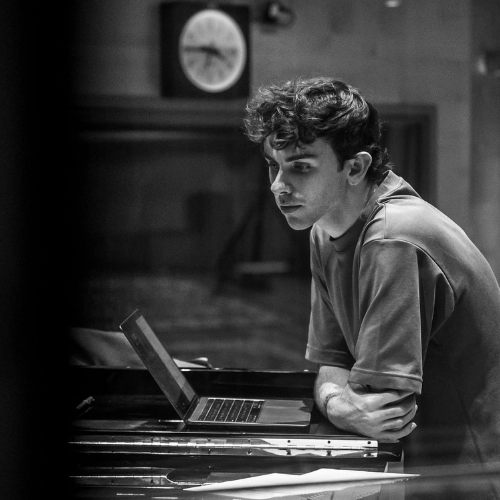
It’s been two years since Alex Turley completed the 2024 Layton Emerging Composer Fellowship program. For this composer, the Fellowship workshop was not simply a development process, it was a moment of transformation. His chamber work Syntax Error, explored in close collaboration with musicians of the Australia Ensemble UNSW, emerged from the experience more refined, more responsive, and ultimately more alive.
Reflecting on the workshop, Turley is clear about its impact. The opportunity to hear the piece in the hands of performers both technically and musically revealed its true character. Some passages held together effectively on the page but felt merely adequate in performance, while others possessed an immediate, almost intangible sense of rightness. Just as telling was the visible response of the musicians themselves.
“There’s a difference between when players are enjoying what they’re doing and when it feels like work,” he notes. “Seeing that in real time helps you understand what’s really communicating.”
That process of listening, observing, and refining allowed Turley to sharpen the work’s most compelling ideas, bringing Syntax Error into a more cohesive and expressive form than would have been possible in isolation.
Yet for Turley, the most significant insights weren’t purely technical; they were human. He describes his compositional approach as deliberately restrained when it comes to evocative language in the score. Rather than prescribing emotional intent, he prioritises clarity of instruction, leaving space for interpretation to emerge collaboratively in rehearsal.
It is in these conversations between composer and performer that the music truly expands. Musicians, he explains, often respond to the work using vivid descriptive language; metaphors, associations, and emotional cues that illuminate possibilities beyond notation.
“What fascinates me is how players find the emotional temperature of a passage,” he reflects. “That’s where you really start to see what a piece can communicate beyond what I can write down.”
For Turley, this exchange is central to chamber music: a shared, in-the-room discovery process that transforms a score into something far richer than the sum of its instructions.
Looking ahead, Turley’s creative momentum shows no sign of slowing. His current projects include orchestral arrangements for two concerts with the Melbourne Symphony Orchestra, featuring artists Emma Donovan and Vera Blue; an undertaking he describes as both demanding and creatively invigorating. The scale of the work offers an opportunity to experiment with orchestration techniques and push his musical language in new directions.
Closer to the chamber world, audiences can also look forward to the premiere of a new work for flute and string quartet by flautist Joshua Batty at the Australian Festival of Chamber Music; another connection that traces back to the collaborative environment of the Layton workshop.
As for Sydney audiences, Turley offers a hint of what’s to come: a major project on the horizon for 2027. Details remain under wraps, but the promise is enough to spark anticipation.
In many ways, Turley’s reflections speak to a broader truth at the heart of the Australia Ensemble’s work. Composition is not a solitary act sealed within a score; it is a living process that unfolds through collaboration, curiosity, and conversation. Through experiences like the Layton Fellowship, composers are given the rare opportunity to test, question, and ultimately deepen their artistic voice; bringing audiences closer to the evolving story of Australian music.
See Turley's Syntax Error at the upcoming Australia Ensemble UNSW concert, book tickets here.