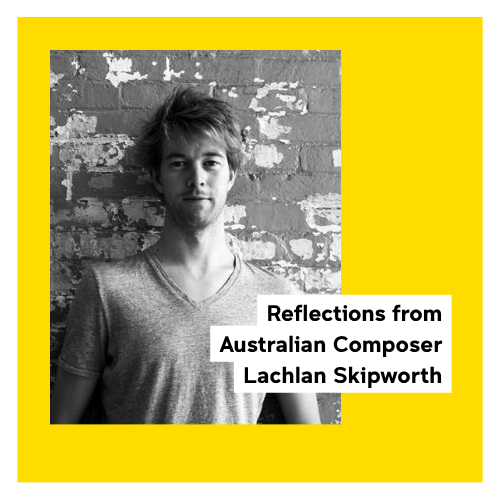
Writing Canticles brought me back into the musical world of the clarinet, after almost a decade during which opportunity seemed to favour commissions for fl ute and oboe among the woodwinds. But make no mistake: clarinet was my fi rst musical love. It was the instrument through which I discovered the great composers, and met music full of beauty, of humour and of great sorrow. It was also where I learned the joy of playing chamber music with friends, and the discipline of long hours alone in the practice room. So Canticles for me is an act of reconciling this core voice within me with my constantly evolving compositional language. Indeed, my style has broadened signifi cantly from the compact emotional landscapes of both my Clarinet Concerto and Clarinet Quintet. While those pieces distil fragile emotions in static yet nuanced sound worlds, Canticles sings with a far greater expressive range. One still hears me drawing out legato phrases in the upper clarion range and dark chalumeau colours down low, yet I no longer shy away from spiky accents and angular leaps when the music builds in energy. Canticles is not so much me going back to the clarinet as it is me giving back to the instrument that shaped my early musical life, and to the players who continue to explore its expressive depth. Yet beyond this personal connection, the piano, violin, and cello are no less vital here, shaping the work’s contours and illuminating the clarinet’s voice in ever-changing ways. The entire life of the piece depends on the conversation between the four instruments, a dialogue of breath, bow, and resonance.
Get to know Lachlan’s music here: https://snd.click/AltioraPeto?pid=vr69j6wUJ3Gn